New
MPAC208 and MPAC208-IECEx Professional Acoustic Imaging Camera
The 208-microphone array localises sound sources instantly, helping maintenance teams act quickly and reduce downtime.
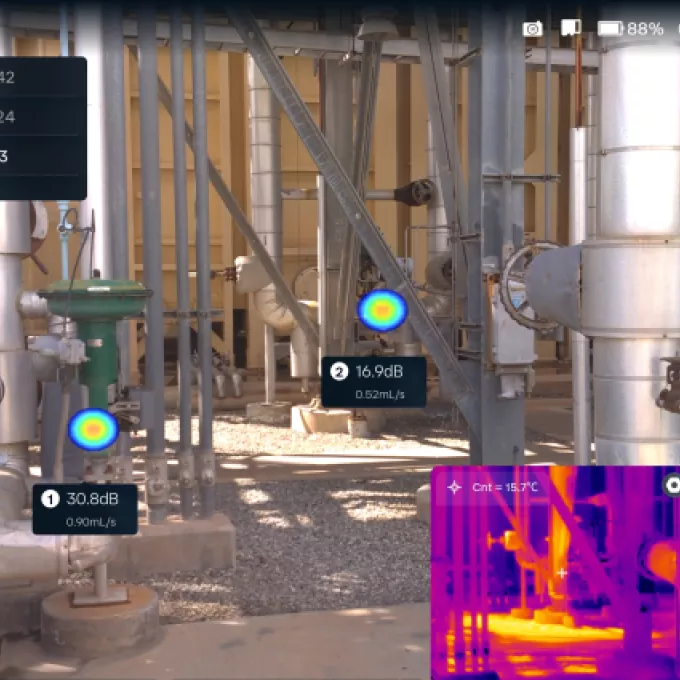
Built-in calculations estimate leak rates and cost impact, supporting data-driven maintenance prioritisation.
PRPD visualisation allows users to identify and differentiate partial discharge types without invasive testing.
Noise suppression and Focus mode isolate target ultrasonic signals even in complex industrial settings.
Thermal image integration supports root cause correlation when heat and acoustic anomalies occur together.
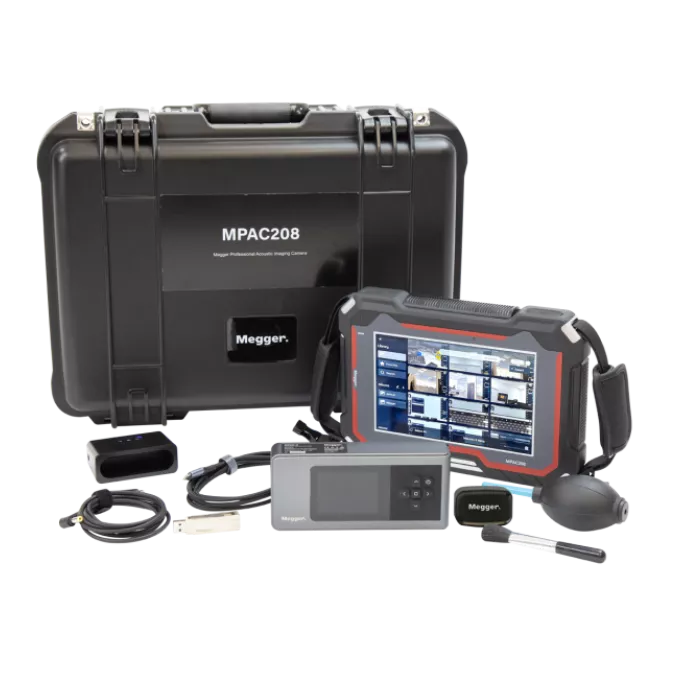
The MPAC208 is available in a PRO Kit, combined with the MPAC-V and MPAC-TM640 as a cost-saving option.
About the product
The MPAC208 is a professional-grade acoustic imaging camera designed for fast, accurate detection of ultrasonic sound sources across industrial environments. It helps maintenance teams identify gas leaks, mechanical deterioration, and partial discharge (PD) in high-voltage electrical systems, without needing to interrupt operations.
At its core is a 208 channel MEMS (micro-electromechanical system) microphone array offering sensitivity across 2 kHz to 100 kHz, enabling the MPAC208 to detect even very small leaks and subtle ultrasonic patterns.
The acoustic data is fused with a 13 MP optical camera and displayed on an 8-inch capacitive touchscreen, presenting clear, real-time visual overlays that make sound sources immediately visible.
The MPAC208-IECEx camera provides all the features seen in the standard MPAC208 but is certified for use in Class 2 explosive atmospheres.
Designed for real industrial environments
With a detection range up to 200 m, the MPAC208 is suitable for both close-proximity inspection and stand-off safety at substations, switchgear, or during overhead line work.
The Focus function suppresses background noise, allowing operators to isolate target sound sources even in loud plants or workshops. SoundScan™ directional guidance assists in locating leaks that are outside the visible frame, helping technicians trace issues quickly
Three core operating modes
- Gas Leak Mode: Automatically estimates leak rate, cost impact, and distance to the source, helping prioritise repairs and quantify energy loss.
- Partial Discharge Mode: Captures PD activity and provides PRPD (Phase Resolved Partial Discharge) analysis, supporting early detection and classification of discharge types.
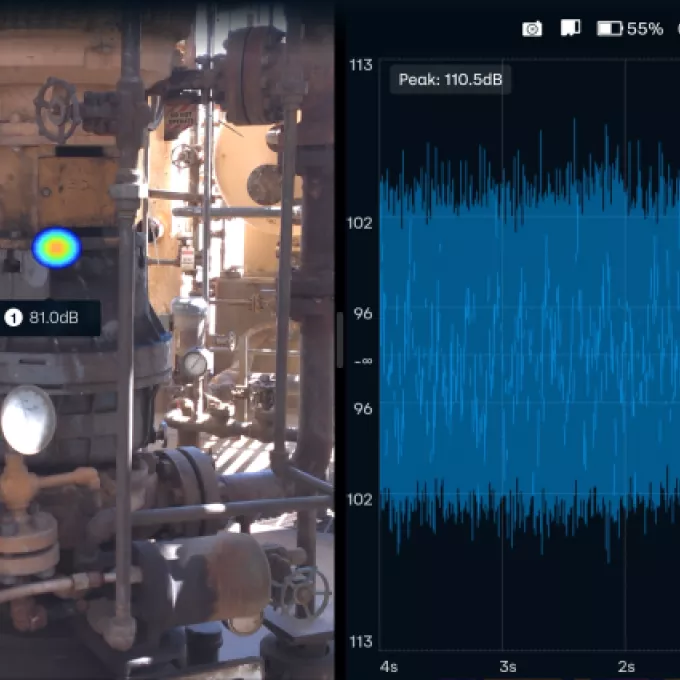
- Mechanical Mode: Identifies bearing wear, valve leakage, cavitation, and vibration-related wear patterns through ultrasonic signatures.
Extend capability with thermal correlation
When fitted with an optional thermal imaging module, the MPAC208 enables side-by-side acoustic and thermal visualisation. This allows users to correlate heat signatures with acoustic anomalies for faster root cause assessment.
Built for field use
The camera is lightweight (1.4 kg), IP54 rated, and powered by interchangeable smart batteries providing up to 10 hours of operation (2× 5-hour packs included).
Whether used in utilities, industrial plants, renewables, or manufacturing, the MPAC208 supports predictive maintenance, energy efficiency, and operational safety—all in one portable instrument.
Camera Verification
The optional MPAC-V accessory is designed to allow field verification of the operational parameters of the MPAC cameras. An automated routine, built into the MPAC cameras, will verify the frequency response as well as the SPL (Sound Pressure Level) measured by the camera. In addition, it checks the visual location calibration of the microphones.
FAQ / Frequently Asked Questions
The MPAC208 detects pressurised and vacuum gas leaks by identifying ultrasonic sound from escaping gas. It can analyse different gas types and provide estimated leak rates and economic loss values.
Yes. In PD mode, it localises discharge sources and provides real-time PRPD analysis to help classify discharge type and severity.
Electric utilities, industrial process plants, manufacturing, renewables, and facilities using compressed air or gas distribution systems.
Not for acoustic inspections. The thermal module is optional and is only needed if you want to correlate heat anomalies with acoustic events.
Further reading and webinars
Troubleshooting
The MPAC series of Acoustic Cameras are equipped with an internal microphone diagnostic test. It is recommended that this feature is run on a regular basis to ensure that all microphones are functioning correctly.
Should the test indicate an issue with any of the microphones, turn off the camera and carefully clean the rear array holes, as described in the user guide, using the provided cleaning tools. If the problem persists, please contact your local Megger service centre.
The MPAC128 has an internal battery used to maintain the date and time within the instrument. This battery has a limited lifespan of between 4 to 6 years. Should the camera date and time require resetting on a regular basis, the camera should be returned to a Megger service centre to have the battery replaced.
If, when verifying the camera accuracy using the MPAC-V, it is determined that re-calibration is required, the camera should be returned to a Megger service centre.
Interpreting test results
The MPAC range of Acoustic Cameras give the user the ability to “see sound”, helping to identify and pin-point the location of partial discharge, compressed air/gas leaks and many mechanical issues.
The Partial discharge signature is displayed using a separate phase resolved graph, giving the user information on the type of PD being measured. In addition, on the MPAC208, a PD count is provided along with the sound pressure level (SPL), to help determine the severity of the PD.
Gas leak quantification is displayed, enabling the user to identify the leak location, the severity of the leak along with a calculated cost. The leak rate is displayed in sound pressure, volumetric and monetary value, enabling the user to determine priority for leak repairs.
Mechanical issues, associated with bearings and motors, as an example, can be detected. Information relating to the frequency and sound pressure level are provided by both the MPAC128 and MPAC208 series cameras.
Using the MPAC208 will provide the user with three additional parameters to help determine the nature of the sound being measured: time-domain, frequency-domain and spectrogram graphs.
User guides and documents
Software and firmware updates
MPAC208 Software
The Megger Analyst software helps the user manage thousands of acoustic images, (as well as thermal images - MPAC208 series only) and videos from their MPAC device. This is compatible with both the MPAC128 as well as the MPAC208 series. This software lets the users dive deeper into the acoustic and thermal images, offering seamless viewing, analysis and editing capabilities for both pictures and videos captured by the MPAC devices. From intricate data examination, to the creation of comprehensive test reports, this tool servers as an indispensable companion in unlocking the full potential of acoustic imaging technology.
FAQ / Frequently Asked Questions
No. The ultrasounds generated by the leak are absorbed by the ground and do not propagate to the device sensors. Therefore, it can’t be detected.
No. Liquid leaks usually don't make noticeable sound waves. And if the leak is visible, there's no need for detection, as it can be seen.
No. SF6 leaks are generally at very low pressure and as such do not generate a sound for the camera to detect.
Prolonged use of the device will not affect its accuracy. However, it is recommend calibration is carried out every two years. This may be extended if regular verification of accuracy is carried out using the MPAC-V verifier. Calibration is currently only through the manufacturer.
In general use, choose 20kHz~40kHz to start. When in quieter environments, and the test point is farther away from the equipment, choosing 15kHz~35kHz is the preferred starting point. When in noisy environments, choosing 28kHz~48kHz is advised.