Multi-phase relay testers for quick fault verification

Ensure protection system reliability with our multi-phase relay testers. Simulate anything from basic to complex fault conditions, verify timing and coordination, prevent failures, and protect critical grid infrastructure.

Modern power systems face increasing complexity from renewables, distributed generation, and evolving load demands. Accurate multi-phase relay testing is essential to maintain grid stability, verify protection coordination, and prevent cascading failures.

Megger’s multi-phase relay test solutions deliver precise performance analysis, fault simulation, and real-world testing for a wide range of protection schemes. From dynamic testing to fault location and system optimization, we help you ensure protection systems work exactly as intended.

Our lightweight yet powerful instruments enable you to detect issues early, reduce unplanned downtime, and gain clear insights into system behaviour—all with the accuracy and confidence Megger is known for.

Frequently asked questions

Yes—Megger has been active in IEC 61850 development since the mid-2000s and launched its first IEC 61850-ready products in 2009. Today, Megger offers FREJA and SMRT test sets that support IEC 61850-based relay testing, with direct access to GOOSE and Sampled Values.

Included in many models are the Megger GOOSE Configurator (MGC) and Sampled Values Analyser (SVA), allowing you to configure and monitor IEC 61850 traffic directly on the device—no external PC required. This setup enhances cyber security and simplifies testing in digital substations, making Megger’s system one of the most complete and secure IEC 61850 test solutions available.

Megger offers a wide range of relay test sets so you can choose the exact model that fits your application and budget—no more, no less.
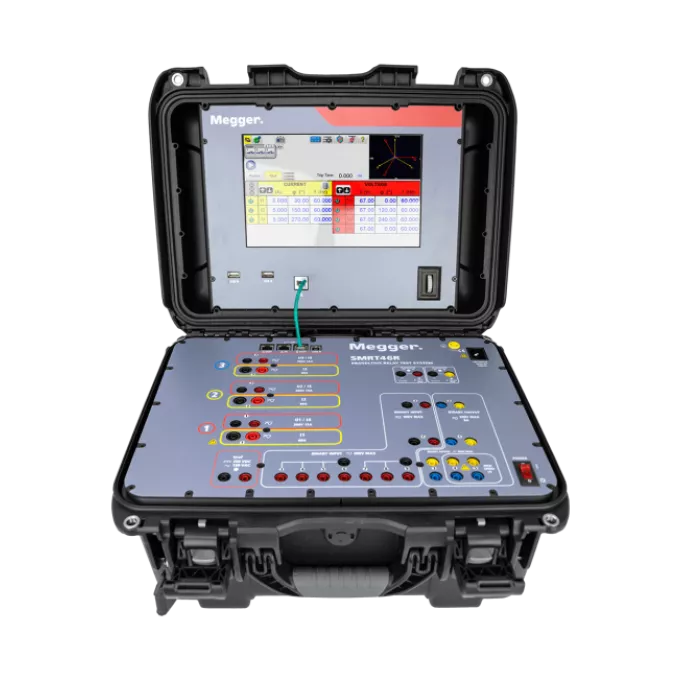
A test set is a significant investment. Buying one with more features than you’ll use can be wasteful, while choosing one too limited may force you into workarounds or early replacement. For example, most protection schemes require three voltages and three currents, but testing functions like synchro-check or transformer differential may need four voltages or six currents. That’s why Megger offers flexible systems like the SMRT46, configurable for both standard and advanced test setups.

Yes, testing high pickup values can overload a relay if high current is applied for too long. Most overcurrent relays shouldn't have more than 10x their rated current applied for more than a second.
Megger solves this with the pulse ramp feature in its SMRT test sets. Instead of a continuous current, the test set injects short, increasing pulses. This protects the relay’s thermal integrity while still allowing you to accurately capture the pickup point—making high-set overcurrent testing safer and more precise.

Yes—Megger’s multi-phase relay test systems are built for more than basic function checks. They support dynamic fault simulations, real-time coordination testing, and end-to-end scheme verification across protection relays.
With advanced timing control, multi-channel output, and software integration, Megger test sets help you simulate realistic grid events and assess full protection schemes—ideal for substations, industrial systems, and digital substation rollouts.

Struggling with complex scheme testing?

Simulating dynamic faults or verifying end-to-end protection logic can eat up hours—and still leave room for error. Speak to a Megger engineer to find the fastest, most accurate multi-phase test configuration for your grid, substation, or industrial setup.

Additional Resources

Explore real-world applications of our relay and systems testing products through these insightful articles.

Testing protection systems in the real world

Get an introduction to GIS testing in this webinar.

Video

The Challenges of Testing Relay Protection in Renewable Power Systems

When testing frequency relays, there are two commonly encountered issues.

Read more

The Importance of IEC 61850 in Relation to the Smart Grid

It’s not just a communication protocol; it’s an electrical system philosophy.

Read more