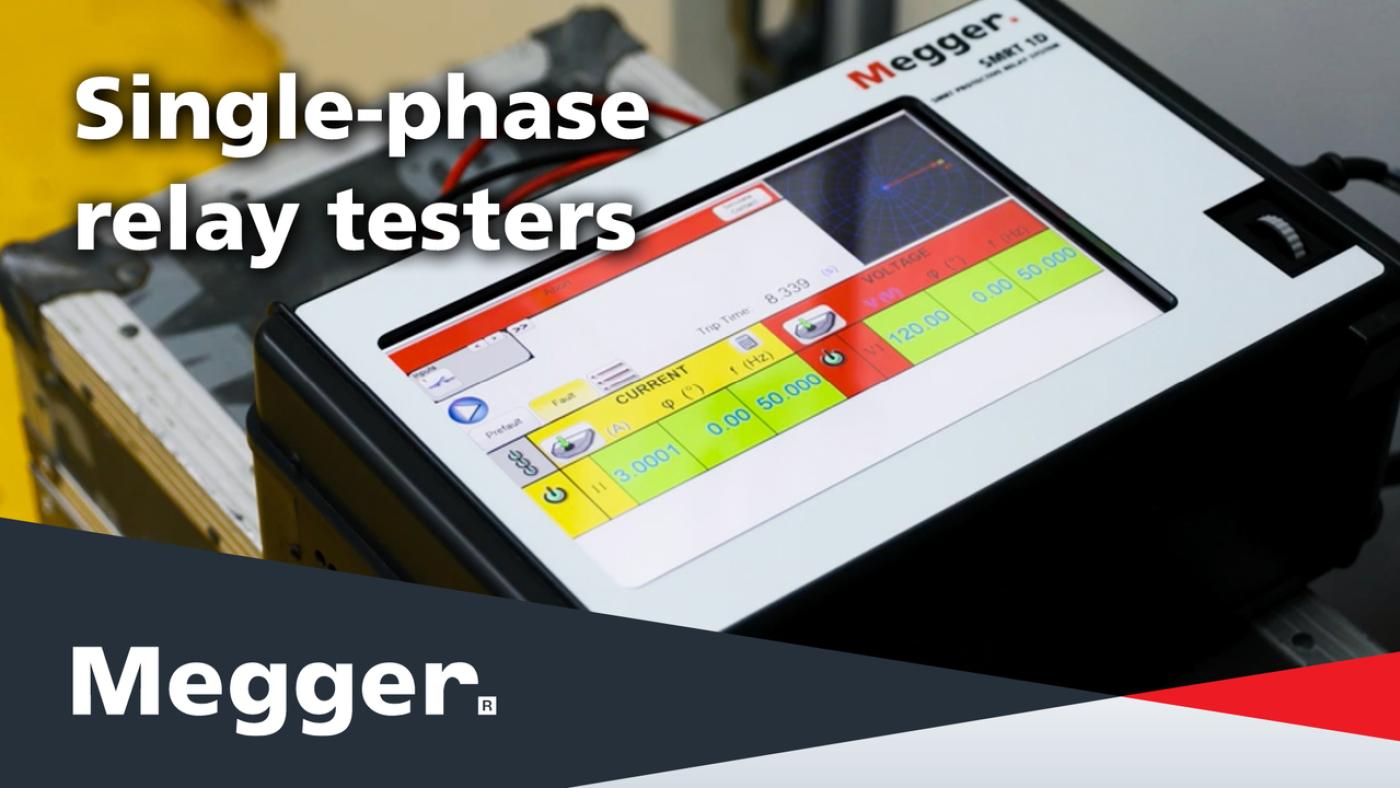
Single-phase relay testers for protection system confidence

Verify protection relays with speed and accuracy using Megger’s single-phase test sets. Prevent faults, optimize system performance, and maintain network reliability—whether in conventional or digital substations.

Reliable protection starts with accurate relay testing. Megger’s single-phase test sets are designed to help you verify relay performance quickly, reduce faults, and optimize system reliability.

Compact, cost-effective, and easy to use, they deliver precise measurements for overcurrent, voltage, and frequency relays across a wide range of applications.

From industrial switchgear to rail power networks, our instruments simplify fault diagnosis, support routine maintenance, and ensure compliance with protection standards.

Built for both field and bench use, Megger’s single-phase solutions give you the confidence to detect issues early, minimize downtime, and keep your protection schemes operating exactly as intended.
Even though being a single-phase relay tester, the unit has same IEC 61850 capability as its multi-phase siblings. Furthermore, multiple single-phase systems can be daisy-chained to act like a multi-phase system.

Frequently Asked Questions

Yes, injecting a continuous high current can thermally overload the relay. Most overcurrent relays should not be exposed to more than 10x their rated current for over one second.
To test high pickup values safely, Megger’s SMRT test sets include a pulse ramp feature. This function applies short current pulses that increase step by step in amplitude. It keeps the relay within its thermal limits while still allowing accurate pickup point measurement. This approach prevents damage and ensures repeatable, safe testing even at high settings.

Single-phase test sets are ideal for testing a wide range of protection relays that operate based on a single input quantity, such as:

  • Overcurrent (50/51)
  • Voltage (59, 27)
  • Frequency (81)
  • Directional elements (with appropriate connections)
  • Ground fault relays

They’re well-suited for routine checks, commissioning, and troubleshooting of relays in substations, industrial facilities, and rail power systems. For multi-element or distance relays, a three-phase set is typically required.
 

In some cases, yes—but with limitations. A single-phase relay test set can test certain functions of a three-phase relay, such as individual overcurrent or undervoltage elements.
However, for functions that require phase relationships, such as differential protection, synchro-check, or distance relays, a three-phase test set is required to simulate realistic power system conditions.
Single-phase sets are ideal for targeted tests and basic troubleshooting, especially in the field or when portability is important.

Not necessarily. Many of Megger’s single-phase relay testers—such as those in the SVERKER series—are fully functional as standalone units. You can perform manual testing, adjust outputs, and measure response times directly from the front panel.
However, using a computer with RTMS software adds automation, custom test plans, and report generation capabilities. So while a PC isn’t required, it can significantly enhance productivity and repeatability, especially during commissioning or large-scale testing.

Need the right single-phase testing solution?

Talk to our relay testing experts about your specific application. Whether you're commissioning, troubleshooting, or maintaining protection systems, we’ll help you find the right single-phase solution—fast, reliable, and ready for the field.

Additional Resources

Explore real-world applications of our relay and systems testing products through these insightful articles.

Testing protection systems in the real world

Get an introduction to GIS testing in this webinar.

Video

The Challenges of Testing Relay Protection in Renewable Power Systems

When testing frequency relays, there are two commonly encountered issues.

Read More

The Importance of IEC 61850 in Relation to the Smart Grid

It’s not just a communication protocol; it’s an electrical system philosophy.

Read More