Bushing Diagnostics: What Frequency-Based Testing Revealed in a 230 kV Case
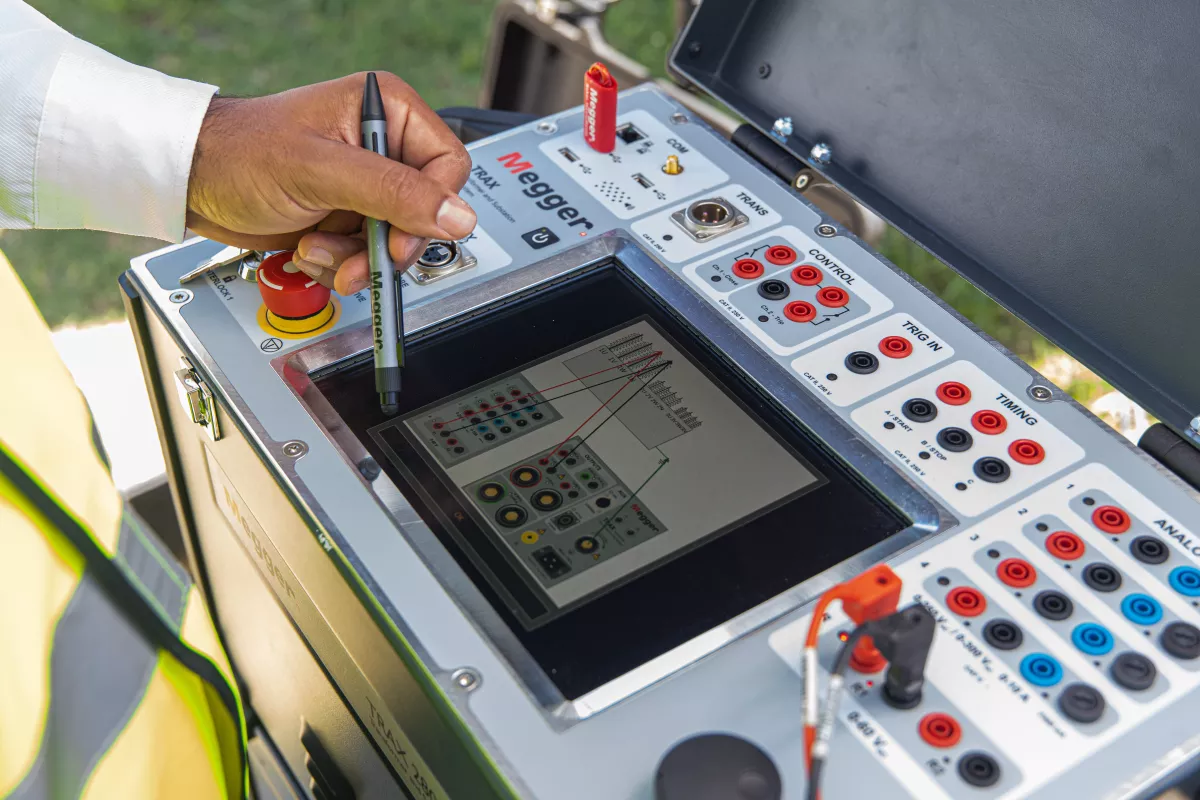
Routine off-line bushing testing usually focuses on capacitance and power factor measurements on the C1 and C2 insulation at power frequency. These tests remain essential, but they do not always provide enough sensitivity to distinguish between internal insulation degradation and external factors such as grounding or installation issues. That creates a problem for maintenance teams: an abnormal result may point to a real defect, or it may point to something else entirely.
A recent investigation involving three 230 kV OIP bushings shows how frequency-based dielectric testing provided the additional insight needed to assess each bushing with greater confidence.
When routine test results raise more questions than answers
The investigation began during routine power factor testing of three 230 kV bushings. Initial 50 Hz measurements showed normal results for Phase A and Phase C, both of which fell within accepted limits. Phase B, however, produced a significantly higher power factor result, indicating a potential insulation problem.
At that stage, the results raised three important questions. Was Phase B affected by internal insulation degradation, or was the abnormal result caused by an external issue such as poor grounding? Were the apparently healthy results for Phases A and C genuinely reassuring? Or could one of those bushings still be hiding an early-stage problem that the 50 Hz test had not revealed clearly?
Making a maintenance decision on the basis of those results alone would have been difficult. Replacing Phase B without understanding the cause could have led to unnecessary intervention, while assuming that Phases A and C were healthy could have left a developing issue undetected. To gain a clearer picture of bushing insulation condition, the investigation was extended beyond the initial 50 Hz measurement to include frequency-based dielectric testing.
Using frequency response to separate different problems
Frequency-based dielectric testing assesses insulation response across a range of test frequencies rather than at a single point. This provides a more detailed view of insulation condition because different degradation mechanisms influence the dielectric response in different ways. By analysing power factor values across frequencies from 1 Hz to 500 Hz, engineers can identify response patterns that point to different types of problems.
In this case, the frequency response analysis revealed three clearly different conditions across the three bushings.
Phase B: Internal insulation degradation
The Phase B bushing showed a very high power factor value at 1 Hz, exceeding 7% after temperature correction. As the test frequency increased, the power factor dropped sharply towards the 50 Hz result. This characteristic response pattern, often described as a ski-slope curve, is a strong indicator of internal insulation deterioration.
This type of response is commonly associated with moisture ingress into the paper insulation or severe oil degradation. Additional voltage dependence observed during the measurements supported that diagnosis. After the Phase B bushing was replaced, subsequent testing confirmed that the abnormal dielectric response was no longer present.
Phase A: Grounding or installation issue
The Phase A bushing initially appeared healthy when tested at 50 Hz. However, the frequency response curve revealed elevated dielectric losses at higher frequencies. That pattern suggested that the abnormal result was caused by an external factor rather than internal insulation degradation. In many cases, this type of response indicates a poor ground connection between the bushing flange and the transformer tank.
After a temporary ground strap was applied and the test repeated, the dielectric losses returned to normal levels. That confirmed the issue was related to grounding rather than the insulation system itself.
Phase C: Healthy insulation condition
The Phase C bushing produced a flat and stable frequency response curve across the full test range. The temperature-corrected 1 Hz power factor value remained well below typical investigation thresholds. This response is consistent with dry, uncontaminated insulation and correct installation. In other words, the frequency-based test did not simply show that Phase C passed at 50 Hz; it provided stronger confirmation that the bushing was in healthy condition.
What this case shows in practice
The value of frequency-based diagnostics in this case was not simply that a fault was identified. The more important outcome was that each bushing could be assessed with greater confidence. Diego explicitly highlighted this decision-support role in his review, stressing that the point is not that frequency necessarily changes the decision, but that it strengthens the information behind it.
Three practical lessons stand out.
First, low-frequency results can provide a clearer indication of internal insulation degradation than line-frequency testing alone. A significant rise in power factor at around 1 Hz is often associated with moisture ingress or advanced ageing within the insulation system.
Second, the shape of the frequency response curve can help distinguish between internal insulation problems and external issues such as grounding or installation errors. That distinction matters because the corrective actions are completely different.
Third, a stable response across the full test range provides stronger confirmation of healthy insulation condition than a single acceptable result at 50 or 60 Hz.
Taken together, these insights allow engineers to move beyond identifying an abnormal number. They help explain the likely cause of the result and support a more confident maintenance decision.
From diagnostic data to more confident decisions
Investigations like this show the value of combining conventional insulation testing with frequency-based diagnostics. Standard 50 or 60 Hz measurements remain an essential part of bushing assessment, but they do not always provide enough information on their own when results are unclear. Frequency-based testing extends the diagnostic view and helps engineers separate internal insulation degradation from external influences while confirming healthy bushings with greater confidence.
This improves the quality of maintenance decisions, reduces the risk of unnecessary replacement, and helps asset managers focus intervention where it is truly needed.
Changing the test frequency does not replace established testing methods. It strengthens the information available for asset decisions.
Explore frequency-based bushing diagnostics
Frequency-based insulation diagnostics provide a deeper understanding of bushing condition and can reveal developing problems that routine testing may not detect clearly.
To learn more about how this approach supports maintenance decisions, explore the test systems that enable frequency-based insulation diagnostics across transformer assets.


