How Online Dissolved Gas Analysis Protects Renewable Assets
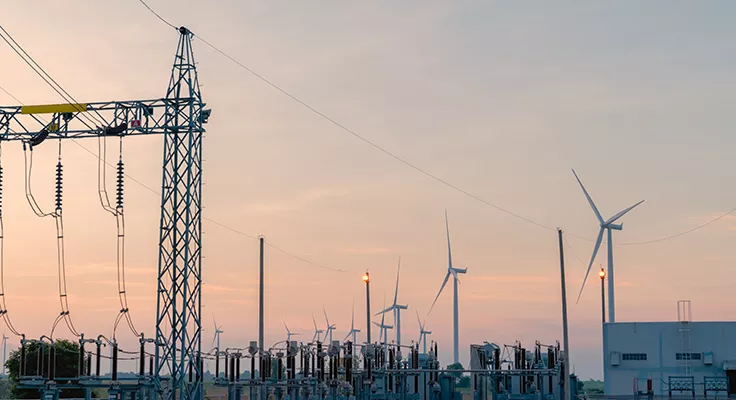
Renewable energy plants rely heavily on main substation transformers (also known as collector transformers) to step up voltages and deliver power to the grid.
A failure in one of these units can halt an entire site's output, costing hundreds of thousands of pounds in lost revenue.
To reduce the risk of unplanned site outage, operators use online dissolved gas analysis (DGA) to detect internal faults in transformers before they escalate into catastrophic failures.
What Are the Common Causes of Transformer Failure?
Inside a transformer, the insulating oil and cellulose paper degrade over time. When subjected to abnormal thermal or electrical stress, these materials break down and release specific (fault) gases into the oil.
Hydrogen is generated by multiple fault types, but hydrogen-only monitoring cannot in some cases reliably determine whether the fault is low-energy or high-energy in nature.
High-energy, high-risk events, like sparking and arcing, always produce acetylene as temperatures at fault location exceed 700 degrees Celsius.
Analysis of dissolved hydrogen and acetylene provides direct visibility into the condition of the transformer's active part, allowing more reliable assessment of fault severity and associated risk than hydrogen-only, hydrogen-plus-carbon-monoxide, or composite-gas monitoring approaches.
Discuss a DGA Strategy for Your Renewable Substation Transformers
Build a unified DGA strategy that maximises uptime, safety, and long-term transformer performance. Chat with us today review your renewable transformer fleet.
How Does Continuous Dissolved Gas Analysis Reduce the Risk of Outages?
Historically, operators relied on offline laboratory testing for dissolved gas analysis. While offline analysis remains the benchmark for understanding asset condition and making final maintenance decisions, taking samples once a year or every few months leaves long gaps where faults can develop undetected.
Continuous online monitoring bridges this gap. It doesn't replace offline lab testing; instead, it measures fault gases to detect faults and reveal the rate of gas generation.
An increase in gas levels beyond the alarm thresholds alerts your team to an active fault. Fast-occurring faults and sudden changes in type of fault between two oil sampling intervals, in most cases cannot be not picked up by manual DGA but only with on-line gas monitors (CIGRE Technical Bulletin 783/2019 Online DGA Monitoring Systems).
Integrating continuous online data with comprehensive offline lab testing forms the most effective strategy for preventing catastrophic failures.
Why Should I Monitor Hydrogen and Acetylene?
Monitoring a targeted combination of gases provides clear, actionable intelligence. Hydrogen can serve as an early warning for a wide range of developing issues. Acetylene acts as a definitive indicator of a severe, high-energy fault.
For example, in case of an arcing fault D1 or D2 in windings, potentially the most dangerous fault in transformers, the acetylene that should be detected is ~ 2 ppm. Only approximately 6 ppm of hydrogen is generated alongside 2 ppm of acetylene (CIGRE Technical Bulletin 783/2019 Online DGA Monitoring Systems).
In this case, a hydrogen-only monitor, a composite-gas monitor, or most hydrogen-plus-carbon-monoxide fault detectors would fail to identify the developing fault, as such a low hydrogen concentration may remain below alarm thresholds or be difficult to distinguish from normal background gas generation.
Furthermore, in many cases monitoring carbon monoxide without considering carbon dioxide provides limited diagnostic value, as carbon monoxide can be produced by a variety of thermal and ageing processes.
This illustrates why acetylene is the most valuable second gas to monitor alongside hydrogen in a two-gas monitoring solution. While hydrogen provides a sensitive indication of developing faults, acetylene is a specific indicator of high-energy electrical activity.
Together, these gases provide significantly better insight into fault severity and urgency than hydrogen-only or hydrogen-plus-carbon-monoxide or composite gas monitoring approaches.
What Is the Best Fault Detector for Renewable Substation Transformers?
While some diagnostic monitors track up to nine different gases, they often come with high costs and complex maintenance requirements. For this reason, operators in general consider them for critical transformers in poor condition and that require online diagnostics.
For a fleet of critical and healthy transformers, operators who want to reduce risk at asset and fleet level while keeping the OPEX budgets under control can consider the Megger InsuLogix G2,which is the most advanced fault detector, focusing precisely on the most critical indicators: hydrogen, acetylene, and moisture.
The InsuLogix G2 uses tuneable diode laser spectroscopy (TDLS) to measure acetylene. This technology provides laboratory-grade sensitivity, detecting acetylene levels as low as 0.5 parts per million.
Because the laser is fine tuned to interact only with acetylene molecules, it eliminates cross-interference from other gases. The TDLS also measures the moisture concentration in the gas sample, after which the InsuLogix G2 software calculates the moisture content in the oil.
The InsuLogix G2 gives you the most sensitive and reliable acetylene measurement for definitive sparking and arcing detection, at a fraction of the cost of multi-gas diagnostic monitors.
How Do I Implement a Continuous Monitoring Strategy?
To protect your renewable energy assets, start by installing the InsuLogix G2 on your most critical substation transformers, where online complete diagnostic is not required.
Connect the InsuLogix G2 monitor to your supervisory control and data acquisition (SCADA) system using standard protocols like Modbus, DNP3 or IEC 61850. Set alarm thresholds for absolute concentration and for rising gas trends.
When the InsuLogix G2 flags an issue, you can schedule an offline lab test to confirm the fault type and plan maintenance during a controlled outage. If required, a fault diagnostic monitor could be installed on the asset for further investigation.
By combining real-time fault detection with scheduled diagnostics, you reduce risk on your transformers, protect your revenue, and ensure a reliable connection to the grid.
Protect Your Renewable Substation Transformers
Contact us today to discuss your renewable asset ecosystem and identify the dissolved gas analysis solution that best supports uptime, safety, and long-term transformer performance.


