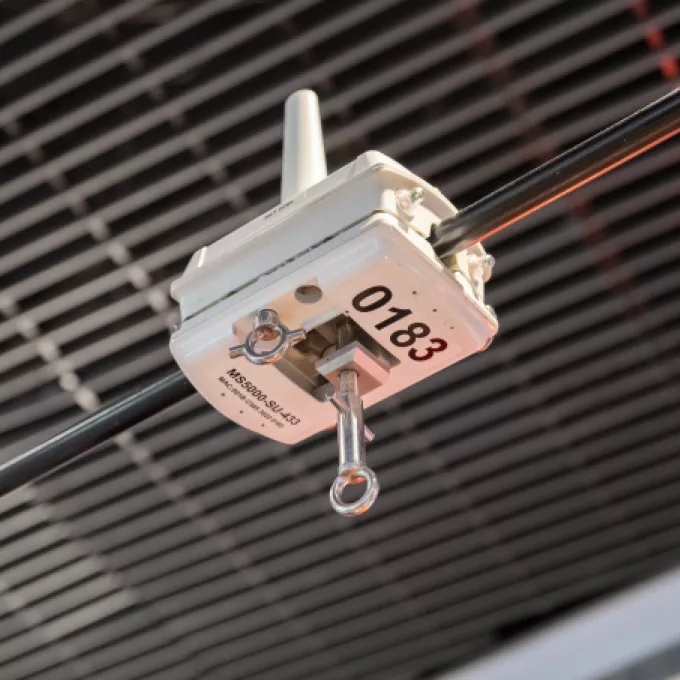
MS5000 – Smart Grid Sensor for Medium Voltage Monitoring
Detects high impedance and transient faults in all grounding systems.
Auto-forming mesh ensures scalable communication, even without cellular.
Operates over 10 years, IP67-rated, -40°C to +70°C.
Real-time measurements of voltage, current, harmonics, and power flow.
Inductive line power from 1.5A, backed by 3-year battery in low-power mode.
About the product
The Megger MS5000 is an advanced smart grid sensor designed for medium voltage overhead line monitoring. This wireless grid monitoring system helps utilities improve reliability through accurate fault detection, power quality monitoring, and real time grid visibility.
The self-powered and maintenance free MS5000 uses a secure IPv6 mesh network to transmit synchronised, time stamped data, even in remote locations without cellular coverage. It captures current, voltage, harmonics, and fault events with exceptional precision and supports solid, floating, and compensated earthing systems.
With rugged IP67 protection, inductive power harvesting, and proven scalability to hundreds of nodes, the MS5000 power quality sensor is ideal for grid analytics, FLISR, overhead line monitoring, and predictive maintenance.
FAQ / Frequently Asked Questions
FLISR (Fault location, isolation, service restoration), grid analytics, wildfire risk reduction, and predictive maintenance.
Yes, it uses mesh radio communication to reach sensors tens of kilometres away without needing cellular coverage.
It starts with 3 sensors and can expand to hundreds, forming a robust mesh network.
Yes, it integrates easily with DMS and supports a wide range of earthing methods and voltages up to 140kV.
It offers high precision, reliable fault detection including high impedance faults, long-term durability, and flexible deployment without cellular reliance.
Further reading and webinars
Related products
Troubleshooting
Check mesh network health, antenna position, and battery status. Use USB interface for diagnostics.
Verify fault detection thresholds and ensure phase synchronisation is active. Inrush blocking setting may delay response, so adjust in configuration.
Ensure the line current exceeds the required minimum (1.5A for SU / 3A–5A for GS). Check for proper clamp contact and clean conductor surface if oxidised or insulated. Confirm correct clamp accessory is used (e.g., MS5000-AC-IN for insulated conductors).
Check mesh network connection strength and ensure synchronisation is active. Review radio frequency environment - interference or improper antenna positioning may impact communication.
Verify that mesh topology includes intermediate nodes if distances exceed single-hop range. High-gain antennas can improve range, so reposition or replace if signal is weak. Check if cellular or Ethernet uplink is functioning properly.
Interpreting test results
Waveforms capture current and voltage changes in high resolution. Use phase-to-ground and surge indicators to confirm fault type. Harmonic distortion and zero-sequence data highlight grid imbalance or power quality issues.
Real and reactive power, along with power factor and harmonics (up to the 5th presented), give a complete picture of power quality. Alarms help isolate overloads, faults, or low battery events.
Consistent phase angle shifts can indicate load imbalances or wiring issues. Zero-sequence values help identify asymmetrical faults or grounding problems, especially in compensated or SWER systems.
The presence of higher-order harmonics (especially 3rd and 5th) may suggest non-linear loads or equipment malfunction. Compare harmonic signatures across phases to pinpoint the source.
Use the synchronised, timestamped data to correlate detected anomalies with grid events such as switching operations, lightning strikes, or substation faults. This enables precise root-cause analysis.
User guides and documents
FAQ / Frequently Asked Questions
Use the USB interface and Megger configuration software, encrypted uploads are supported.
Blinking signals include power down, low battery, reset state, or communication fault. Refer to the LED status table in the user guide.
Simply install the new sensors using a grip-all hot stick or insulated gloves. They automatically join the existing mesh network when powered and within radio range, so no manual configuration is required.
If powered inductively, the sensor will resume operation once current returns. Backup batteries provide continued functionality in low-power mode for up to 3 years. Data continuity depends on backup status and grid current flow.