Power transformer testing and diagnostics

Understand transformer health and make confident decisions

Understand the true condition of your transformers and make confident asset decisions. Megger’s testing and diagnostics solutions give you dependable data to detect emerging issues early and determine whether to maintain, repair, or replace critical assets while reducing risk and downtime. 

Protect personnel and critical transformer assets

Test your transformers safely using Megger’s purpose-built diagnostic solutions. Dependable measurements and guided test workflows help you reduce risk to personnel, obtain trustworthy results, and protect transformer condition throughout the asset lifecycle. 

Ensure reliable transformer operation and uptime

Identify potential issues early and proactively plan maintenance. Megger’s diagnostic solutions help prevent unexpected failures, extend transformer life, and ensure reliable operation across your power grid. 

Make informed decisions with diagnostic data

Gain predictive insight into transformer condition to make informed asset decisions. Megger’s diagnostic solutions help you identify emerging risks and decide whether to maintain, repair, or replace assets while optimising performance and long-term investment planning.

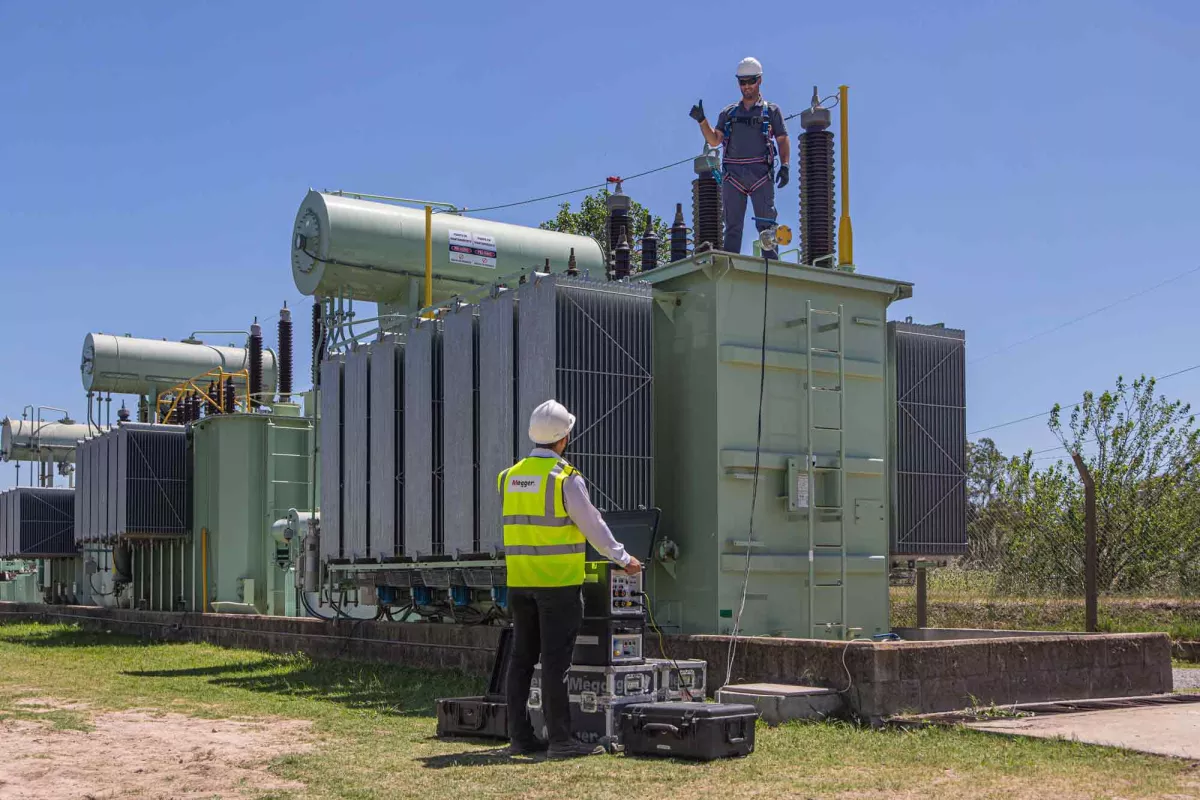
Technicians using Megger dissolved gas analyser (DGA) tools to monitor a power transformer.

Dissolved Gas Analysis (DGA) Online Monitoring for Transformer Assets

Find out more

Multi-function Transformer Test Systems

Find out more

Transformer Insulation Testing

Find out more

Insulating Oil Test Equipment for Transformer Fluid Analysis

Find out more

Transformer Winding Resistance Testing

Find out more
Megger operative conducting a short circuit test on a transformer in a substation environment

Transformer Short-Circuit Impedance

Find out more
Engineer performing vector group testing of transformer

Transformer Turns Ratio Testing

Find out more

Transformer Frequency Response Analysis

Find out more

Frequently asked questions

Maintenance (or replacement) decisions about a transformer should be informed by the unit's insulation condition and expected loading. Adding just a few operational years to the predicted end-of-life for a transformer (or generator, or cable) by optimising its working condition based on reliable diagnostic data means substantial cost savings for the equipment owner. A transformer owner can also use FDS technology to assess the condition and ageing of the insulation in bushings, CTs, VTs, and other components.

Service life of power or distribution transformers starts with a healthy electro-mechanical, electro-magnetic, dielectric, and thermal assessment of the transformer during the factory acceptance test (FAT).

Throughout its service life, a transformer is subjected to several stressing factors that may or may not affect its reliability and operability. Therefore, asset managers and operation managers set specific maintenance and testing strategies to monitor, evaluate and determine the condition of a transformer. A proactive testing and monitoring strategy promotes the longevity of transformers securing safe and continuous operation as well as resilience in the event of unexpected system transient conditions. 

Turns ratio is typically the first test performed on a transformer. It is a pass/fail test. If a transformer fails, it is likely there are significant issues that need to be addressed before other tests are performed. If the transformer passes the turns ratio test, winding resistance is logically the next test to verify that the mechanical integrity of connections within the transformer, bushing, and tap changers. A resistance imbalance can lead to faster degradation of the transformer. Always remember to demagnetise the transformer after winding resistance tests! Residual magnetisation can cause large inrush currents when the transformer is energised, leading to time-consuming and costly nuisance tripping of protection systems. Also, residual magnetisation may affect SFRA, ratio and excitation current test results.

A transformer turns ratio test checks the fundamental principle of operation and design of a transformer. It validates the nameplate information and the electro-magnetic energy conversion phenomenal. The test is also known simply as a turns ratio test. A TTR test is performed by a ratio meter (ratio tester). A TTR test should be performed to confirm that the transformer’s capability for automatic voltage regulation at different tap positions of an OLTC (on-load tap changer) and also to confirm that a de-energised tap changer (DETC) is properly positioned and that shorted windings turns do not exist. The ratio meter provides convenient and accurate readings of power transformer ratios and polarities. A transformer turns ratio test works in accordance with the same fundamental electromagnetic phenomena that the transformer operates. The difference is that the TTR test typically uses a low voltage (LV) AC excitation signal (< 250 V AC) on a per-phase base or as a three-phase simultaneous excitation and measures the induced voltage in the opposite winding. When the excitation signal is applied on the HV winding and measurement is carried out in the LV side, the process is called STEP DOWN ratio test. Although, the test can be carried out exciting the LV winding and measuring the induced voltage on the HV winding, this is called STEP UP ratio test.

Moisture that accumulates in the insulating system of a power transformer affects several properties:

  • Limits the loading capability as higher moisture levels decrease the bubble inception temperature
  • Lowers the dielectric strength of the oil, which has a direct effect on the insulation properties
  • Accelerates aging of the cellulose insulation, lessening its mechanical strength and shortening its service life as a consequence.

Dielectric Frequency Response (DFR a.k.a FDS) is the only reliable method to determine the moisture content in the solid insulation of power and distribution transformers. This test is not invasive and non-destructive. Typically, line-frequency (50 or 60 Hz) tan delta/power factor tests can give misleading results due to temperature effects, and oil analysis is unreliable as moisture mainly resides in the solid insulation.

More about how to protect the health and lifespan of your transformers

Megger’s testing and monitoring equipment and solutions for transformers and HV assets guarantee accuracy, reliability, safety and smart investing.

Additional Resources

Take a deeper dive into transformer testing instruments through our comprehensive guides.

Reducing Risk of Failure on HV Instrument Transformers

Explore an application of narrowband dielectric frequency response (NB DFR) on HV CVTs.

Read More

Misleading Line Frequency Insulation Results on a Contaminated Transformer

A complete protocol of tests, including a 10 kV LF PF test.

Read More

Pinpointing Concealed Problems Inside a Resistive- type OLTC Before Physical Inspection

Read the case study about the Electric Power Transmission Network in Karbala.

Read More

Identifying Aging and Installation Issues in an HV Bushing

Read our case study on 1 and 500 Hz analysis on bushings.

Read More

What is Melting Here?

A heavily used furnace transformer was tested after an operating failure.

Read More

Transformer testing equipment catalogue

Get catalogue