Benefits of Integrated Acoustic and Thermal Imaging
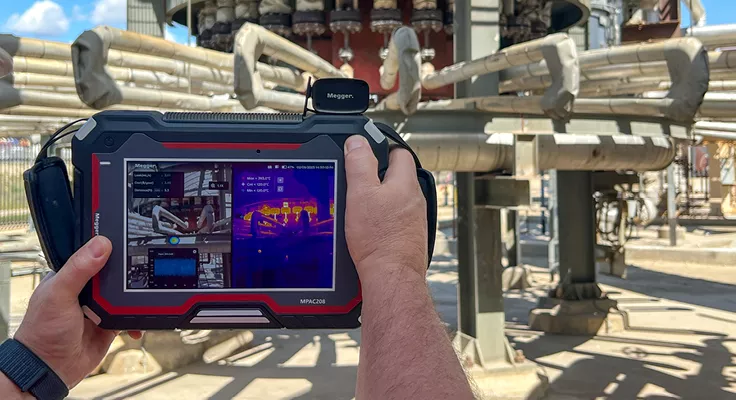
The benefits of an integrated acoustic and thermal imaging camera
Critical faults — whether partial discharge, gas leaks, or mechanical wear — almost never present a single, easily identified signal. Instead, faults manifest through a combination of sound, heat, and vibration. Relying on a single diagnostic technology often leads to incomplete data, uncertainty, and missed opportunities for early intervention.
This article outlines how integrated acoustic and thermal imaging directly addresses this issue.
Acoustic Imaging: What It Is and What It Detects
Acoustic imaging technology visualises ultrasonic and audible sound waves in real time. By mapping these sound fields onto a live video feed, acoustic cameras enable users to locate the exact source of a fault without direct contact, even from distances up to 200 metres. This provides a significant advantage over conventional ultrasonic probes, which require physical proximity and sequential testing.
Key Fault Types Detected by Acoustic Imaging:
- Gas and compressed air leaks: Turbulent flow through leak apertures generates unique ultrasonic patterns. The camera highlights these locations instantly, supporting rapid surveys of even complex, congested facilities.
- Partial discharge: High- and medium-voltage equipment experiencing corona, tracking, or surface discharge emits distinct ultrasonic emissions. Detection from a safe working distance is critical in hazardous or energised environments.
- Mechanical faults: Early-stage bearing wear, misalignment, and imbalance each produce characteristic sound signatures. Early detection prevents escalation and supports predictive maintenance strategies.
The acoustic spectrogram, a vital tool within these systems, provides a frequency-domain view of detected signals. This helps engineers to distinguish between fault types and minimise false positives, even within noisy plant environments. Furthermore, acoustic cameras often include modulated-audio output which translates ultrasonic signals into audible frequencies for accelerated operator training and more intuitive fault recognition.
Thermal Imaging: Capabilities and Strengths
Thermal imaging cameras detect infrared radiation to visualise temperature variations across surfaces. They are invaluable for highlighting heat-based evidence of asset degradation, rapidly identifying:
- Resistive heating: Resulting from loose or corroded electrical connections.
- Insulation breakdown: In medium- and high voltage (HV) systems.
- Frictional heating: Associated with bearing wear, imbalance, or lubrication loss.
- Unbalanced phases and overload: In electrical distribution systems.
While thermal imaging indicates the presence and severity of heat-generating faults, it cannot always determine their root cause. For example, partial discharge can develop to a critical state before producing noticeable thermal anomalies. That's why integration with acoustic technology is essential for an accurate diagnosis.
Why Integration Changes Everything
Acoustic and thermal imaging are complementary technologies. By correlating data from both sources, integrated inspections remove diagnostic ambiguity, reduce reliance on assumptions, and ensure that maintenance decisions are based on verifiable evidence.
Consider a switchgear inspection: a thermal camera may reveal a localised hot spot, which could stem from a loose bolt causing resistive heating or from early-stage partial discharge posing safety risks. With integrated acoustic and thermal technology, an acoustic assessment immediately confirms or rules out partial discharge, resulting in accurate, data-driven decisions.
This cross-verification improves diagnostic confidence and substantially reduces the risk of misdiagnosis. It also increases operational efficiency as dual-mode surveys reduce site visits, labour costs, and production interruptions. And finally, it enhances safety thanks to non-contact detection that enables personnel to assess machines from a safe distance, particularly in high voltage (HV) or hazardous environments.
Applications Across Asset Types
Electrical Systems: Partial Discharge Detection
Partial discharge is a precursor to insulation failure in medium- and high voltage (HV) assets. If left undetected, it can progress to catastrophic breakdowns and hazardous arc incidents.
- Acoustic imaging identifies PD activity by capturing the unique ultrasonic signature of corona and tracking events.
- Thermal imaging detects heat generation from resistive joints or subsequent insulation degradation.
Combined, they offer early warning, enable trend tracking, and support condition-based maintenance—reducing the frequency and scope of emergency repairs.
Gas and Vacuum Systems: Leak Detection and Quantification
Compressed gas leaks are a major source of energy waste in industry.
- Acoustic imaging rapidly locates leaks by identifying ultrasonic turbulence and quantifying severity—even in noisy or expansive environments.
- Thermal imaging visualises cooling effects as escaping gases absorb heat, confirming leak locations and supporting cost-benefit repair analysis.
This combined approach improves detection accuracy and leverages on-screen leak cost calculators to prioritise repairs according to financial impact.
Mechanical Systems: Bearing Faults, Misalignment, and Predictive Maintenance
Early intervention in mechanical degradation prevents unplanned downtime.
- Acoustic imaging reveals early-stage faults such as bearing wear or misalignment through tell-tale sound signatures.
- Thermal imaging confirms frictional heating or lubrication failures identified acoustically, establishing the severity and urgency of corrective action.
Across successive inspections, teams can analyse trends, refine schedules, and direct efforts where they deliver the highest return on investment.
The Strategic Value for Maintenance Programs
Integrated acoustic and thermal imaging establishes the foundation for a data-driven, predictive maintenance strategy. Each survey produces structured digital records, such as spectrograms, thermal images, discharge counts, and leak cost estimates. These records accumulate into a longitudinal health profile for every asset and provide actionable insights for long-term asset management.
With continuous monitoring, teams are able to analyse trends, identify patterns of deterioration, and intervene before critical failures arise. This proactive approach improves reliability and aligns with compliance and sustainability frameworks, including ISO 50001, which require systematic detection and quantification of energy losses.
The result is a clear return on investment through reduced maintenance costs, less unplanned downtime, and extended asset life.
Conclusion: A Unified Diagnostic Ecosystem
By integrating acoustic and thermal imaging within a single inspection workflow, maintenance teams achieve faster fault detection, greater diagnostic confidence, and a safer working environment. For operators responsible for complex electrical, mechanical, and pneumatic assets, dual-technology solutions such as the MPAC208 Pro Kit represent a step change in reliability, efficiency, and strategic insight.
To discover how integrated acoustic and thermal imaging can transform your maintenance approach, get in touch today.


