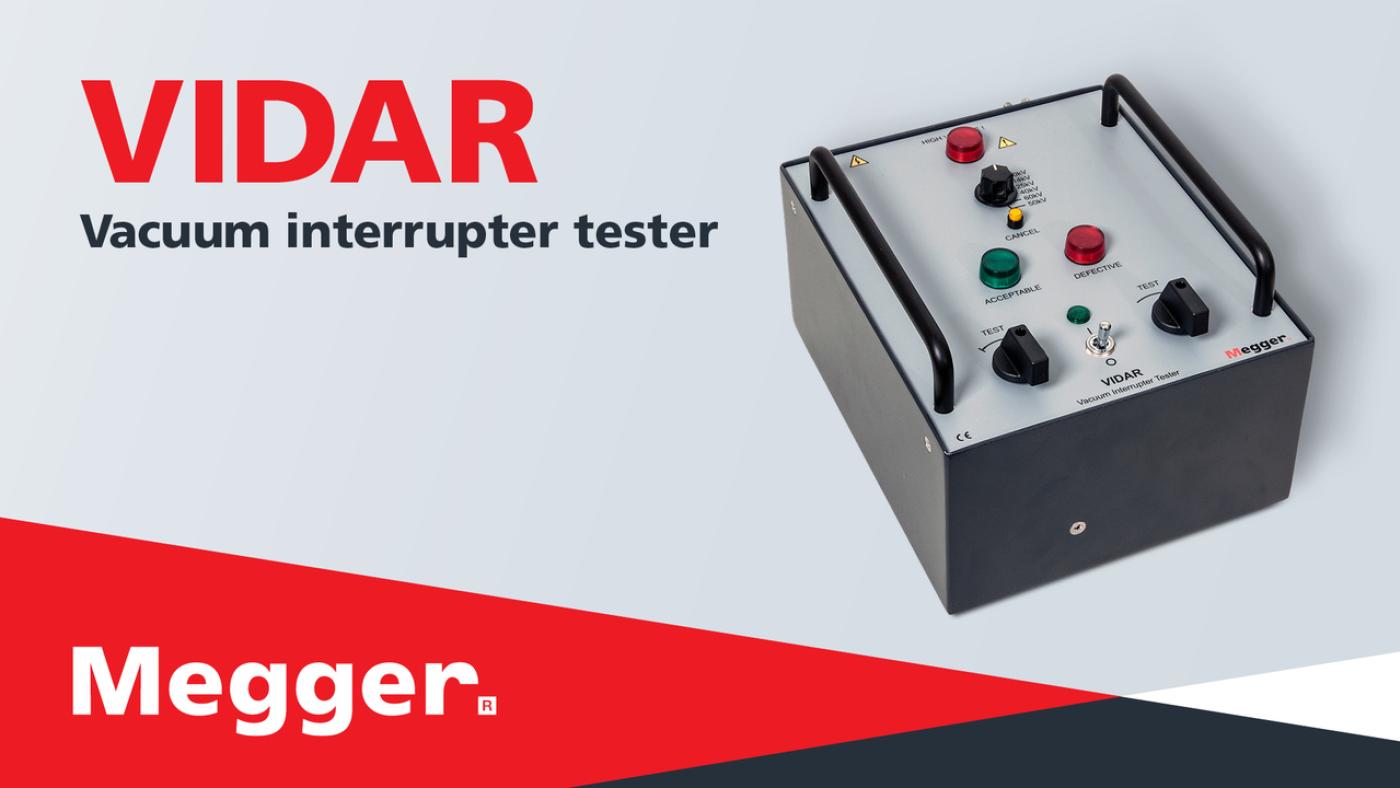
VIDAR Vacuum interrupter tester
VIDAR enables you to check the integrity of the vacuum interrupter quickly and conveniently by means of the known relationship between the flashover voltage and the integrity of the vacuum interrupter.
VIDAR permits you to select among test voltages from 10 to 60 kV DC.
One of the voltages is customized and specified by the customer when ordering.
The VIDAR can be kept in the transport case during the test.
It weighs only 7 kg (15lbs).
About the product
The VIDAR vacuum interrupter tester enables you to check the integrity of the vacuum interrupter quickly and conveniently by means of the known relationship between the flashover voltage and the vacuum interrupter.
A suitable test voltage (DC) is applied to the breaker and the result is known immediately. You can select test voltages from 10 to 60 kV DC and one of these voltages can be customised to your specifications when ordering. Reading the unit is also easy: if the interrupter is approved, a green light is shown, if it is defective, a red light is shown. It requires two-handed control and comes with a warning light that comes on if high voltage is detected, both of which enhance your safety.
The VIDAR vacuum interrupter tester is used to test the ability of the vacuum chamber to inhibit flashovers. It has been developed in close collaboration with leading manufacturers of vacuum circuit breakers. It is rugged, compact, weighs only about 7 kg (15 lbs), and is easy to use since vacuum chambers do not have to be dismounted for testing This makes the VIDAR ideal for use in the field or shop floor applications.
FAQ / Frequently Asked Questions
DC test equipment weighs less, is very easy to use and costs less to purchase. As an alternative to the high DC voltage Vidar utilises, a high AC voltage can also be used. The electrical resistance of the vacuum in a breaker is identical in behavior for AC and DC. The main difference in using DC vs. AC is that AC also is sensitive to the capacitance of the breaker. The DC (resistive) current component is 100 to 1000 times lower in magnitude than the AC (capacitive) current component, depending on the individual bottle capacitance and therefore difficult to distinguish when testing using AC. As a result AC requires much heavier equipment for testing compared to the 7 kg Vidar.
There is one customised voltage that you decide when you buy your VIDAR. That voltage should be between 10-60 kV.
You need to select the Sécheron model. Part no BR-29092.
Further reading and webinars
Related products
Troubleshooting
The HIGH-VOLTAGE warning lamp is probably faulty.
Wrong mains voltage.
Interpreting test results
Make sure the bottle surface is dry and clean and redo the same test.
Try changing the cable clamp positions to opposite position. The black clamp should be connected to the side, where the mechanism is mounted.
FAQ / Frequently Asked Questions
To choose DC test voltage:
- Use DC test voltage recommended from the circuit breaker manufacturer.
- Calculate DC test voltage with the recommended AC test voltage from the Circuit breaker manufacturer.AC test voltage * √2=DC test voltage
- If you have no information of test voltages. Use the nominal AC voltage of the circuit breaker and calculate the DC test voltage as follows.2,5*U nominal DC = DC test voltage
One common mistake in handling Vidar is failing to clean the outside of the vacuum bottle. If the surface is polluted it becomes conductive for low currents under the applied high voltage DC. The consequence is that a vacuum bottle in good shape is failed by the test.
The limit for pass is that the measured current is lower than 0,3 mA.
Connect the black cable to the side, which has the operating mechanism.