Safer transformer testing in solar fields and wind farms – why one setup matters
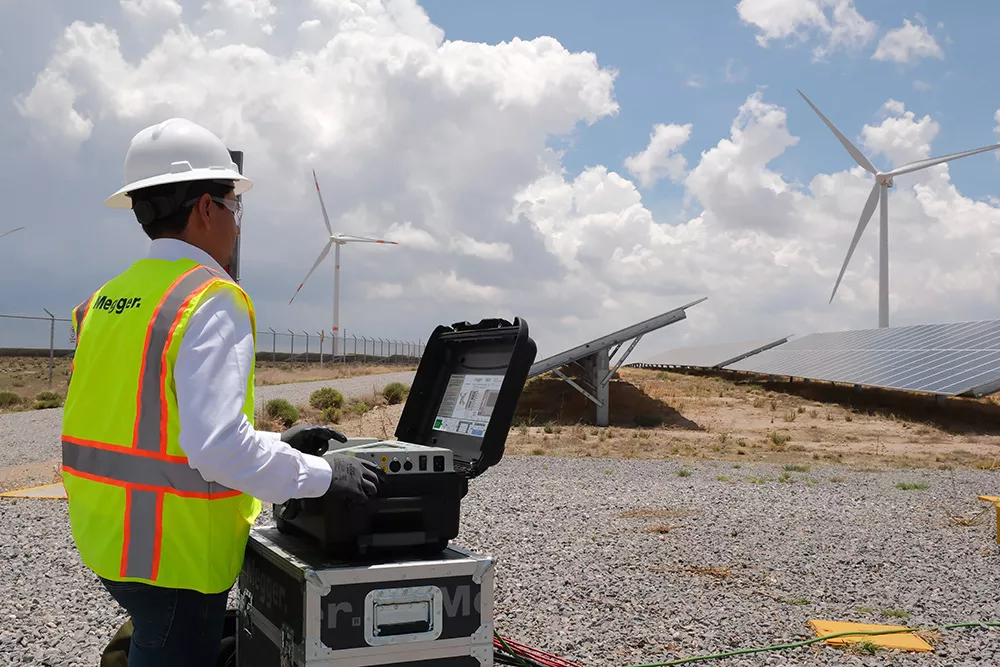
Whether you’re in the confined space of a wind turbine nacelle or on the exposed pad of a solar transformer, every climb, connection, and movement adds risk and time to the job.
High-voltage environments demand extra care — and every additional setup increases the chance of a safety incident. That’s why reducing the number of climbs and cable changes isn’t just about efficiency; it’s a direct improvement to operator safety.
The problem with traditional testing workflows
In many renewable environments, transformer testing means setting up and dismantling equipment several times for different tests: winding resistance, turns ratio, vector group, short-circuit impedance, demagnetization, and efficiency measurement.
Each test typically requires a fresh set of connections. That means:
- More time in high-voltage areas
- Repeated climbing or relocation
- Additional handling of leads and connections
- Greater potential for errors or connection faults
In wind farms, that might involve multiple ascents to the nacelle or repeated climbs inside the tower.
In solar fields, it could mean carrying heavy gear across uneven terrain to reach widely spaced transformer pads. Every reconnection increases not only fatigue but also the risk of electrical incidents and manual handling injuries.

One-time connection: changing the safety equation
The TAU3 transformer winding analyser is designed to streamline this process.
By connecting once to the transformer bushings, you can perform multiple critical transformer tests without touching the leads again.
This includes:
- Vector group confirmation
- Turns ratio and polarity
- Winding resistance
- Demagnetization
- Short-circuit impedance
- Efficiency measurements
Fewer climbs, fewer disconnections, and fewer opportunities for something to go wrong.
Why less exposure means more safety
High-voltage environments — especially in renewable energy sites — are not places you want to linger. Exposure to live equipment, the risk of falls from height, and the physical strain of repeated climbs are all hazards that increase with every additional setup.
With TAU3’s one-time connection:
- Wind farms: You can complete all tests during a single visit to the nacelle or collector transformer, reducing the number of ascents.
- Solar fields: You stay in one location per transformer, avoiding multiple trips between pads or between the substation and the array.
Less time in hazardous zones means lower risk for you and your team.
.jpg?changed=1765796301)
Built for renewable workflows
Renewable sites are tough on equipment. Offshore wind farms bring salt spray and humidity; solar farms can mean dust, heat, and sudden weather changes. The TAU3 is built to handle these realities, with:
- A rugged, weather-resistant transport case
- Lightweight design for easier carrying up ladders or across sites
- Universal lead set with colour-coded clamps for quick, correct connection
- On-screen vector diagrams to verify setup before testing
These features don’t just make the work easier — they also reduce the likelihood of setup errors that can cause delays or unsafe conditions.
Accuracy without compromise
Some engineers worry that combining tests into a single setup might affect accuracy. In reality, TAU3’s true three-phase output improves both speed and precision.
- All three windings are energized and measured simultaneously.
- There’s no need to repeat tests for each phase.
- Results are consistent and repeatable, giving you confidence in your maintenance decisions.
When you’re under pressure to get a turbine or solar array back online, knowing you’ve got reliable, accurate results the first time is invaluable.

Real-world example: wind farm testing
A wind farm maintenance team needs to complete annual transformer checks on multiple turbines. Using traditional methods, each turbine might require two or three climbs to complete all tests, plus lead changes in the nacelle. With the TAU3, the team connects once, completes all tests in a single sequence, and exports results on the spot. The reduced climbs not only speed up the job but also cut the team’s time at height by more than half.
Real-world example: solar farm testing
In a large solar installation, transformers are spread across the site. Traditionally, testing each unit means hauling multiple instruments to each location, setting up, testing, packing up, and moving on — sometimes dozens of times in a day. With TAU3’s portability and one-time connection, the same work can be completed in fewer steps, with less equipment to carry and faster relocation between sites.
The business case for safer, faster testing
Safety is reason enough to rethink the way transformer testing is done, but there’s also a clear business benefit. Faster, safer workflows mean:
- Less downtime for customers’ assets
- Fewer delays caused by repeated setup or rework
- Lower labour costs through reduced site time
- Consistent reporting with USB export and PowerDB integration for immediate data sharing
The TAU3 is not just a testing device — it’s a tool for increasing productivity while keeping your team safer.
Stay safer while keeping workflows efficient
Transformer testing doesn’t have to be a high-risk, drawn-out process. By combining multiple core tests into a single, efficient setup, the TAU3 helps renewable energy professionals work smarter, reduce exposure to hazards, and deliver faster, more reliable results.
Download the TAU3 Safety & Efficiency Guide
See how one-time connection can transform your workflow in solar and wind environments.
Need more information to keep your renewable energy systems efficient? Contact our expert team


