Cut Guesswork — Not Corners: How Re>Act Mode Helps You Retest Sooner and Test Smarter
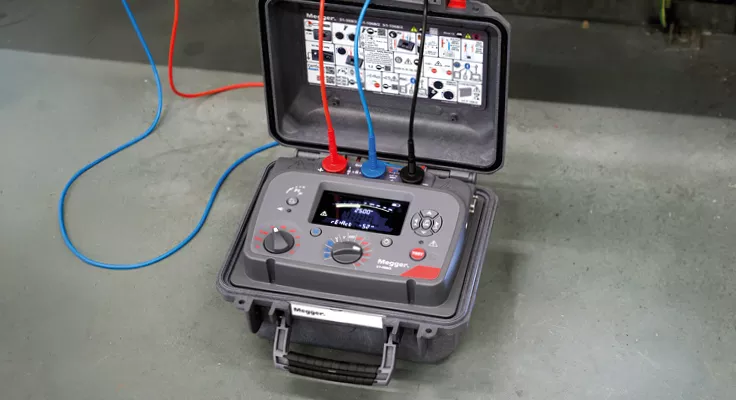
You’re ready to test again — but your insulation might not be.
Even after the voltage drops, residual charge from the previous test can still affect your next result. That’s why standards like IEEE 43 and IEEE 95 recommend waiting up to four times the duration of your last insulation test before running another.
That’s a long time to sit around. Especially when the real issue isn’t time — it’s knowing when your insulation is truly ready.
That’s where Re>Act Mode comes in.
Why Retesting Too Soon Can Go Wrong
When insulation is tested, it polarises — building up a slow-decaying absorption current. Once the test stops, that current reverses direction (depolarisation), creating what’s known as reabsorption current.
If you retest too soon:
- That reabsorption current can oppose your test current
- The result can be too high or too low
- You might pass insulation that should fail — or fail insulation that’s perfectly good
And if the residual current is strong enough, it can even create a hazardous return voltage — where previously charged insulation effectively recharges itself.
What Re>Act Mode Does Differently
Re>Act Mode doesn’t guess — it monitors.
Instead of forcing you to wait a fixed time, Re>Act Mode measures the standing current at the terminals and shows you exactly when it’s safe to retest. It even shows you which parts of the insulation resistance scale are still affected — so you’re never testing blind.
Key benefits:
- Real-time residual current monitoring
- Visual indication of test accuracy via blocked/unblocked scale
- Improved confidence in IR and PI test results
- Reduced wait time — only as long as necessary
- Enhances safety by reducing return voltage risk and avoiding false pass results.
And if you're looking to speed up the test itself, not just the time between them, see how PI Predictor™ can save time during diagnostic testing.
When Re>Act Mode Really Proves Its Worth
You won’t need it for every job — but when you do, it can save hours of retesting delays and protect the quality of your data.
It’s especially useful for:
- Transformers with multiple insulation tests back-to-back
- Cables where cores are tested in sequence
- High-voltage equipment where reabsorption current is significant
- Sites with limited time or technician availability
- Safety-critical environments where accuracy matters most
Smarter testing for safer results
Re>Act Mode doesn’t skip safety steps or bypass discharge.
It manages discharge better, using onboard monitoring to ensure conditions are safe for the next test. By giving you a live view of residual current and its impact on your next test, you get:
- More accurate readings
- Fewer false fails or passes
- Confidence that your insulation is fully discharged
- A reduced risk of dangerous return voltages
This is test visibility you can act on — not just a timer to sit through. It’s protection without pause — and a smarter way to stay ahead on site.
Re>Act Mode is just one of several features that make the Mark 2 range smarter. Don’t miss these other overlooked time-savers and safety features.
Which Testers Include Re>Act Mode?
Every model in the MIT and S1 Mark 2 range includes Re>Act Mode as standard — across the Essential, Advanced, and Expert levels.
Because smarter retesting shouldn’t be a premium extra. Testers with Re>Act Mode don’t just save time — they change what’s possible on a packed job list.
Keep Your Team Moving
Re>Act Mode isn’t just a feature. It’s a new way to approach retesting — built for technicians who need accurate results, fast answers, and total confidence.


