¿Cómo pueden diagnosticar problemas eléctricos las mediciones estáticas?
A motor repair shop receives a three-phase induction motor that has unexpectedly failed. The maintenance team reported that it was tripping its overcurrent protection without any obvious external cause. The initial visual inspection shows no signs of overheating or mechanical damage, leaving the shop technicians with a puzzle.
To avoid a repeat failure after the repair, they need to pinpoint the exact root cause of the problem. This is where a systematic approach using static motor testing becomes indispensable.
Before returning a motor to service, it is crucial to perform a series of offline electrical tests to verify the integrity of its windings and insulation system. Static testing provides a comprehensive diagnostic overview, allowing technicians to identify faults that are not visible to the naked eye.
By applying a sequence of proven electrical tests, a motor shop can confidently diagnose underlying issues, ensure the quality of their repairs, and prevent premature failures once the motor is back in operation.
What Are The Key Static Electrical Tests?
A thorough static testing regime involves a variety of tests, each designed to assess a specific aspect of the motor's electrical health. A comprehensive analysis relies on a combination of these tests to build a complete picture.
- Winding Resistance: This test measures the DC resistance of the motor windings. Unbalanced resistance between phases can indicate a problem such as a poor connection, a broken conductor, or a short circuit between turns.
- Insulation Resistance (IR): The IR test evaluates the quality of the groundwall insulation. It measures the resistance between the motor windings and the ground, providing a clear indication of contamination, moisture, or thermal degradation.
- Polarisation Index (PI) and Dielectric Absorption (DA): These are time-based insulation resistance tests. The PI ratio (the ratio of the insulation resistance at 10 minutes to the resistance at 1 minute) helps determine the insulation's ability to store a charge. A low PI value often points to contamination or moisture within the insulation system.
- DC Step Voltage and Hi-Pot: These high-voltage tests stress the insulation to reveal weaknesses that may not be apparent at normal operating voltages. A step voltage test gradually increases the voltage to identify tracking or breakdown points, while a Hi-Pot test confirms the insulation's dielectric strength.
- Surge Test: This is arguably the most critical test for identifying turn-to-turn insulation weaknesses. By applying high-voltage, fast-rising pulses to the windings, a surge test can detect subtle insulation defects, such as shorts or weak insulation between turns, which are a leading cause of motor failures.
How Does Surge Testing Enhance Fault Detection?
While all static tests are important, the surge test is particularly effective at finding the faults that other tests miss. Weakness in the turn-to-turn insulation is a common failure mode, often initiated by electrical, thermal, or mechanical stresses. These minor insulation flaws can lead to short circuits, causing localised overheating and progressive winding damage that ultimately results in complete motor failure.
Conventional low-voltage tests like winding resistance measurement may not have the sensitivity to detect these incipient faults. A surge test, however, creates a voltage difference between adjacent turns, replicating the stresses experienced during motor start-up or under transient voltage conditions. This makes it an essential diagnostic tool for ensuring the long-term reliability of a motor. When combined with partial discharge measurements, surge testing can also identify end-winding contamination and thermal ageing in the insulation.
What Common Faults Can Static Testing Identify?
By implementing a rigorous static testing programme, motor shops can effectively diagnose a wide range of common motor and generator faults before they escalate.
Key faults detectable through static testing include:
- Ground Insulation Problems: Degraded groundwall insulation can lead to leakage currents and eventual short circuits. This is readily identified with IR, PI, and Hi-Pot tests.
- Weak Insulation Between Turns: As discussed, this is a primary cause of winding failure and is best detected using a surge test.
- Short Circuit Between Turns: A complete turn-to-turn short circuit causes severe localised heating and rapid damage. A surge test will immediately identify this condition.
- Contact Resistance Faults: High resistance at terminal connections can be pinpointed using a four-wire Kelvin low-resistance test, preventing localised heating and voltage drops.
Building Confidence with Comprehensive Testing
For motor shops, the ability to accurately diagnose and verify repairs is fundamental to their reputation and success. A motor that fails shortly after being serviced not only leads to costly downtime for the customer but also damages the shop's credibility. Static testing provides the quality assurance needed to stand behind your work.
By integrating a suite of static tests into the repair process, technicians can validate the quality of a rewind, confirm the integrity of the insulation system, and ensure that no latent faults remain. This systematic approach transforms motor repair from a reactive task to a proactive process, extending equipment lifespan and providing peace of mind for both the repair shop and the end-user.
Equip Your Shop with Advanced Static Testers
To perform these critical diagnostic tests effectively, your technicians need reliable, accurate, and robust equipment. Megger offers a comprehensive portfolio of market-leading static motor testing solutions designed for the demanding environment of a motor repair shop.
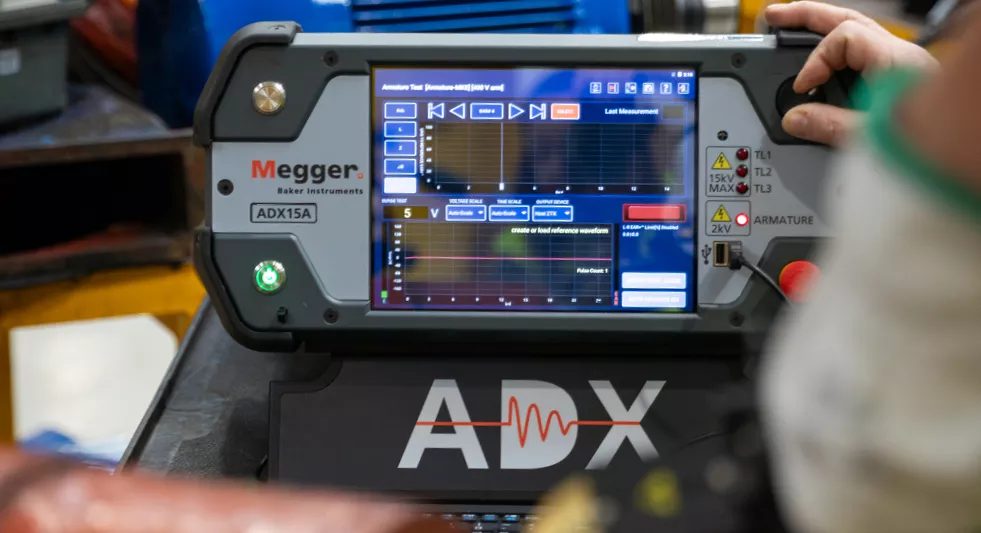
From the handheld MTR105 Rotating Machine Tester to the advanced Baker ADX and AWA-IV Automated Static Motor Analysers, our instruments provide the full spectrum of tests required for a complete motor diagnosis. These tools are engineered to deliver precise, repeatable results, giving you complete confidence in your maintenance and repair operations.
Explore our range of motor and generator testing products to see how Megger can help you enhance your diagnostic capabilities and ensure the reliability of every motor you service.


